
Mescaline
Naturally occurring psychedelic alkaloid from cacti, first naturally occurring psychedelic characterized by Western science.
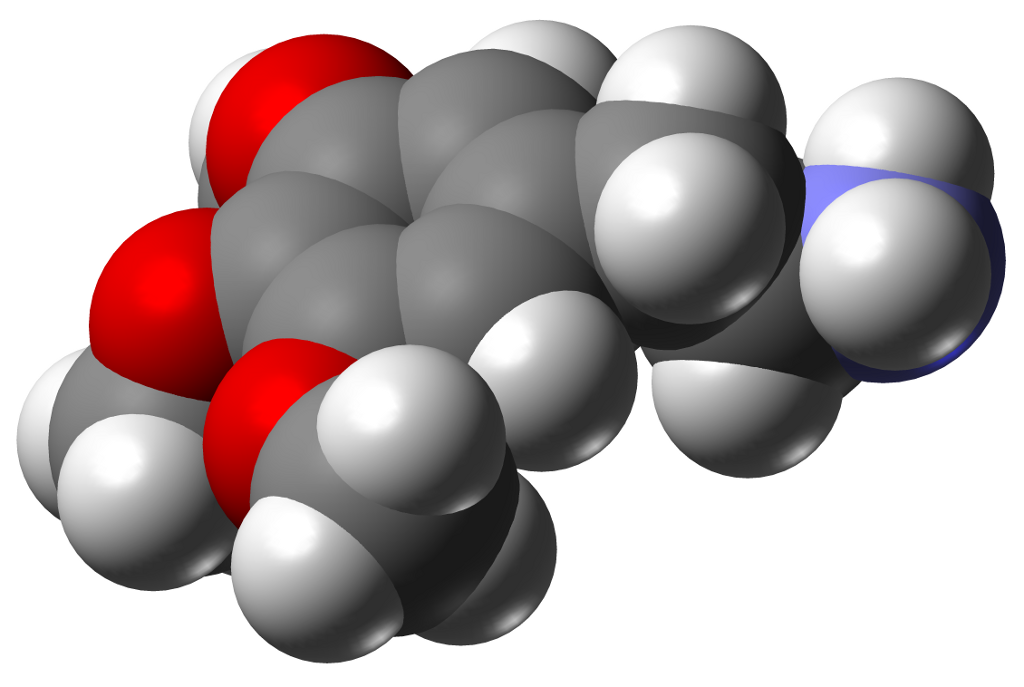
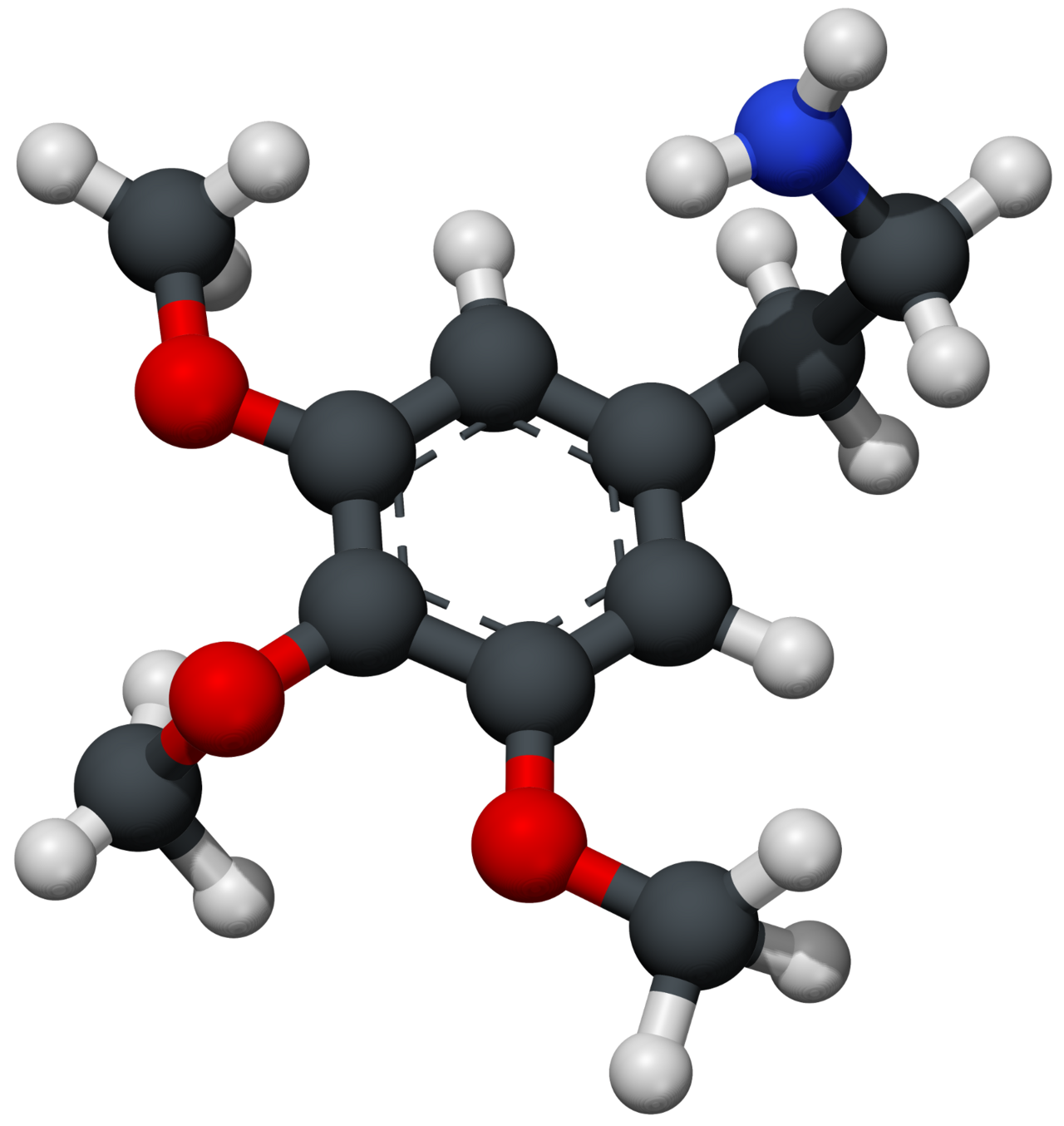
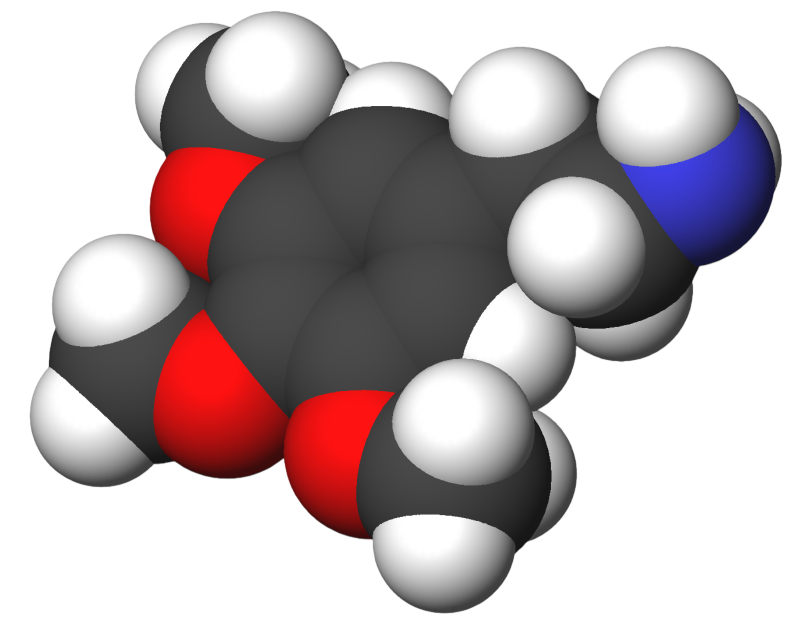
Mescaline, chemically designated as 3,4,5-trimethoxyphenethylamine, is a naturally occurring psychedelic alkaloid from the phenethylamine and scaline families. It is found in cacti like peyote (Lophophora williamsii) and the San Pedro cactus (Echinopsis pachanoi and related species). People use it for recreation, spiritual purposes, and medical exploration. When taken orally as the hydrochloride salt, psychedelic effects appear at doses between 100 and 800 mg, and it can be consumed either in purified form or as part of mescaline-containing cacti. The experience it produces includes visual changes, altered perception of time, space, and self, synesthesia, and spiritual sensations. Effects begin 30 to 60 minutes after ingestion, peak between 2 and 4 hours, and last from 6 to 14 hours, with duration increasing alongside dose.
Mescaline works mainly as a partial agonist at serotonin 5-HT2A receptors, though it also interacts with various other receptors and targets with differing affinity and efficacy. The drug's psychoactive effects can be blocked by the 5-HT2A receptor antagonist ketanserin. It is a relatively hydrophilic compound structurally related to dopamine. First synthesized in 1919, numerous synthetic methods and potent analogues have been developed since. In nature, it occurs in various cactus species at widely varying concentrations, and plants biosynthesize it from amino acids such as phenylalanine and tyrosine.
Human consumption of mescaline-containing cacti stretches back more than 6,000 years. Scientific study of peyote cacti began in the 1800s, leading to the isolation of mescaline as the active psychedelic ingredient. This work also resulted in legal recognition of its religious use and ongoing investigation into its therapeutic potential and that of related analogues. Mescaline was the first psychedelic compound characterized by Western science and has been called the "first psychedelic."
Mescaline and the cacti that produce it are largely illegal worldwide, though exceptions exist for religious, scientific, or ornamental purposes. The compound has influenced many notable cultural figures, including Aldous Huxley and Alexander Shulgin. Very few human studies on mescaline were conducted after the early 1970s, but research into its effects and potential medical applications resumed in the early 2020s.
**Use and effects**
Mescaline is taken recreationally, spiritually, and medically, typically by mouth. Psychedelic doses range from 100 to 1,000 mg orally. Low doses are 100 to 200 mg, an intermediate or "good effect" dose is around 500 mg, and a high dose (leading to ego dissolution) is about 1,000 mg. In his book *PiHKAL*, Alexander Shulgin listed a dose range of 200 to 400 mg as the sulfate salt and 178 to 356 mg as the hydrochloride salt. Microdosing involves daily doses below 75 mg. Besides pure mescaline, people also use cacti such as peyote and San Pedro. Doses for fresh or dried cactus preparations have also been described.
In traditional peyote use, the top of the cactus is cut off, leaving the large taproot and a ring of green tissue to regrow new heads. These heads are dried into disc-shaped buttons. Buttons are chewed or soaked in water to drink. Because the taste is bitter, modern users often grind the dried buttons into powder and put it into capsules. An average 76 mm (3.0 inch) peyote button contains about 25 mg of mescaline. Analyses of traditional San Pedro cactus preparations have found total alkaloid doses ranging from 34 mg to 159 mg, a relatively low and barely psychoactive amount. It appears that patients receiving traditional San Pedro treatments ingest sub-psychoactive doses and do not experience psychedelic effects.
After oral ingestion, mescaline's effects begin on average within 0.5 to 0.9 hours, with a range of 0.1 to 2.7 hours. Effects peak after 1.9 to 4.0 hours on average, with a range of 0.5 to 8.0 hours. Duration is dose-dependent: at 100 mg, it lasts about 6.4 hours on average (range 3.0–10 hours); at moderate doses of 300 to 500 mg, it lasts 9.7 to 11 hours on average (range 5.6–22 hours); and at 800 mg, it lasts about 14 hours on average (range 7.2–22 hours). Cases of unusually prolonged or delayed effects have also been reported.
Mescaline produces a psychedelic state similar to LSD and psilocybin but with unique features. Subjective effects can include altered thinking, changes in time perception and self-awareness, and closed- and open-eye visual phenomena. In *PiHKAL*, Shulgin compiled experience reports describing brightened colors, increased visual contrast, open-eye visuals such as colors and patterns, pareidolia, heightened significance of objects, enhanced music appreciation, a feeling of intoxication, self-analysis, insights, increased body awareness, joy, happiness, peacefulness, hyperactivity and energy, empathy, a sense of ridiculousness, humor and laughter, religious feelings, restlessness, social discomfort and avoidance, and nausea. Mescaline was one of Shulgin's "magical half-dozen" psychedelic drugs in *PiHKAL*.
Color prominence is distinctive with mescaline, appearing brilliant and intense. Recurring visual patterns include stripes, checkerboards, angular spikes, multicolor dots, and simple fractals that can become very complex. In his autobiographical book *The Doors of Perception* (1954), Aldous Huxley described these self-transforming amorphous shapes as like animated stained glass illuminated by light coming through the eyelids. Like LSD, mescaline's effects also involve...
- chemical_name
- 3,4,5-trimethoxyphenethylamine
- class
- Psychedelic drug, alkaloid, phenethylamine
- natural_sources
- Peyote (Lophophora williamsii), San Pedro cactus (Echinopsis pachanoi)
- duration_of_effects
- 6 to 14 hours, dose-dependent
- primary_mechanism
- Partial agonist at serotonin 5-HT2A receptors
Lore & Background
Mescaline is a naturally occurring psychedelic alkaloid found in several cactus species, most notably peyote (*Lophophora williamsii*) and the San Pedro cactus (*Echinopsis pachanoi* and others). The compound is biosynthesized in these plants from the amino acids phenylalanine and tyrosine. Its concentration varies widely among species and individual specimens; for example, an average peyote button contains about 25 milligrams of mescaline. The drug is relatively hydrophilic and is structurally related to dopamine. Chemically known as 3,4,5-trimethoxyphenethylamine, it belongs to the phenethylamine and scaline families. Mescaline was first synthesized in 1919, and numerous synthetic methods and potent analogues have been developed since. The human use of mescaline-containing cacti dates back over 6,000 years. Peyote cacti were scientifically studied in the 1800s, leading to the isolation of mescaline as the active psychedelic constituent. It was the first psychedelic compound characterized by Western science and has been called the "first psychedelic." The drug acts primarily as a partial agonist at serotonin 5-HT2A receptors, and its psychoactive effects can be blocked by the antagonist ketanserin. Mescaline and its source cacti are largely illegal worldwide, though exceptions exist for religious, scientific, or ornamental use. Notable cultural figures influenced by mescaline include Aldous Huxley and Alexander Shulgin.
Reader's Guide
Mescaline is significant as the first psychedelic compound characterized by the Western world, influencing notable cultural figures such as Aldous Huxley and Alexander Shulgin. It induces a psychedelic state comparable to LSD and psilocybin but with unique characteristics, including prominent color enhancement and geometric visual patterns. Despite being largely illegal worldwide, exceptions exist for religious, scientific, or ornamental use. Very few human studies were conducted after the early 1970s, but research resumed in the early 2020s to explore its effects and potential medical use. Mescaline's slow onset and distinctive visual phenomena, such as the 'cobweb figure' described by Heinrich Klüver, contribute to its lasting cultural and scientific legacy.
Did You Know?
- A 76 mm peyote button typically contains hundreds of milligrams of mescaline, not just 25 mg.
- Aldous Huxley described mescaline-induced visual effects as 'animated stained glass' in his book The Doors of Perception.
- Mescaline is a relatively hydrophilic compound structurally related to dopamine.
Chemical Identity & Botanical Origins
Mescaline carries the systematic name 3,4,5-trimethoxyphenethylamine, placing it within both the phenethylamine and scaline alkaloid families. Structurally, it is a relatively hydrophilic molecule that bears a close resemblance to dopamine, a neurotransmitter well known in neuroscience. In the natural world, the compound is produced by certain cacti—most famously peyote (Lophophora williamsii) and the San Pedro cactus (Echinopsis pachanoi)—where it is biosynthesized from common amino acids such as phenylalanine and tyrosine. Concentrations of the alkaloid vary widely from one cactus species to another, and even between individual plants. Although mescaline has existed in these desert plants for millennia, its formal entry into Western chemistry came in 1919, when it was first synthesized in a laboratory. Since that pioneering work, researchers have developed numerous additional synthetic routes and have created a wide array of potent analogues, expanding the chemical family far beyond the original natural compound.
The Psychedelic Experience
When taken orally at doses of roughly 100 to 800 milligrams, mescaline produces a full psychedelic state spanning many hours. Effects typically begin within thirty to sixty minutes, peak between two and four hours, and persist from six to fourteen hours depending on the dose. The experience features vivid visual phenomena, a distorted sense of time and personal identity, synesthetic blending of the senses, and often a profound spiritual quality. Color takes center stage: hues appear brilliant and hyper-intense, while recurring geometric patterns—stripes, checkerboards, angular spikes, multicolored dots, and simple fractals that grow increasingly complex—dominate the visual field. Aldous Huxley, in his 1954 memoir The Doors of Perception, likened these shifting shapes to animated stained glass lit from behind the eyelids. In the 1920s, Heinrich Klüver identified four form-constant hallucinations in the early phase of a mescaline trip, the most famous being the cobweb figure, a whirl of colored threads converging on a revolving center. Unlike LSD, mescaline's kaleidoscopic imagery tends to manifest most clearly with the eyes closed and under dim lighting. Alexander Shulgin, who catalogued subjective reports in his book PiHKAL, counted mescaline among his magical half-dozen of psychedelic compounds.
Ancient Roots & Cultural Legacy
The human relationship with mescaline-containing cacti stretches back more than six thousand years, making it one of the oldest psychoactive traditions on record. In traditional peyote preparation, the top of the cactus is severed while the large tap root and a ring of green photosynthesizing tissue are left intact so new heads can regenerate. Those harvested heads are dried into disc-shaped buttons, each averaging about 76 millimeters and containing roughly 25 milligrams of mescaline. Because the cactus has a bitter taste, many modern users grind the dried material into powder and enclose it in capsules rather than chewing it. The San Pedro cactus, by contrast, has been analyzed in traditional preparations and found to contain only 34 to 159 milligrams of total alkaloids—amounts that appear sub-psychoactive, suggesting patients in those traditional treatments do not experience full psychedelic effects. Today, mescaline and the cacti that produce it are largely illegal across the globe, though narrow exceptions exist for religious, scientific, and ornamental purposes. The compound has nonetheless left a deep imprint on Western culture, influencing figures as diverse as Aldous Huxley and Alexander Shulgin. As the first psychedelic compound ever characterized by Western science, mescaline has been called the first psychedelic.
Pharmacology & the Research Gap
At the molecular level, mescaline functions primarily as a partial agonist at serotonin 5-HT2A receptors, though it also shows varying degrees of affinity and efficacy at several other receptor targets. The psychoactive effects of the drug can be blocked by ketanserin, a 5-HT2A receptor antagonist, confirming the centrality of that particular receptor in mediating the psychedelic experience. Mescaline is used in recreational, spiritual, and medical contexts, and microdosing protocols involving daily doses below 75 milligrams have also been described. Despite its long history and cultural significance, very few controlled studies of mescaline in human subjects were conducted after the early 1970s, creating a substantial gap in the scientific literature. Peyote cacti were first studied scientifically in the 1800s, and the isolation of mescaline as the active psychedelic constituent in cacti marked a pivotal moment in pharmacology. Legal recognition of religious use followed, and the compound's therapeutic potential has been explored intermittently. As of the early 2020s, renewed interest has driven fresh research into mescaline's effects and its possible medical applications, reopening a line of inquiry that had been largely dormant for decades.
Gallery



Frequently Asked Questions
What is Mescaline?
Mescaline is a naturally occurring psychedelic alkaloid belonging to the phenethylamine family, most commonly found in cacti such as peyote and San Pedro. It is widely regarded as the first psychedelic compound ever identified by Western science.
Where does Mescaline occur naturally?
The compound is a native alkaloid of specific cacti, primarily peyote (Lophophora williamsii) and the San Pedro cactus (Echinopsis pachanoi). It is produced by these plants rather than being a synthetic substance.
Why is Mescaline considered historically significant?
Because it was the first psychedelic substance ever characterized by Western researchers, it is frequently called the 'first psychedelic.' Its identification opened the door to the broader scientific and cultural study of psychedelic compounds.
More in Medications And Drugs 1-24
Spotted an error? Know more?
This is a living reference — every entry is fact-audited, and reader corrections feed straight into our audit queue. Suggest an edit · See this site's audit record