
Local anesthetic
Medication causing local loss of sensation without unconsciousness.

Seaborg · CC BY-SA 3.0
A local anesthetic (LA) is a medication that causes absence of all sensation, including pain, in a specific body part without loss of consciousness, providing local anesthesia. This contrasts with a general anesthetic, which eliminates sensation in the entire body and induces unconsciousness. Local anesthetics are most commonly used to eliminate pain during or after surgery, and when used on specific nerve pathways, they can also cause a temporary motor block.
- classification
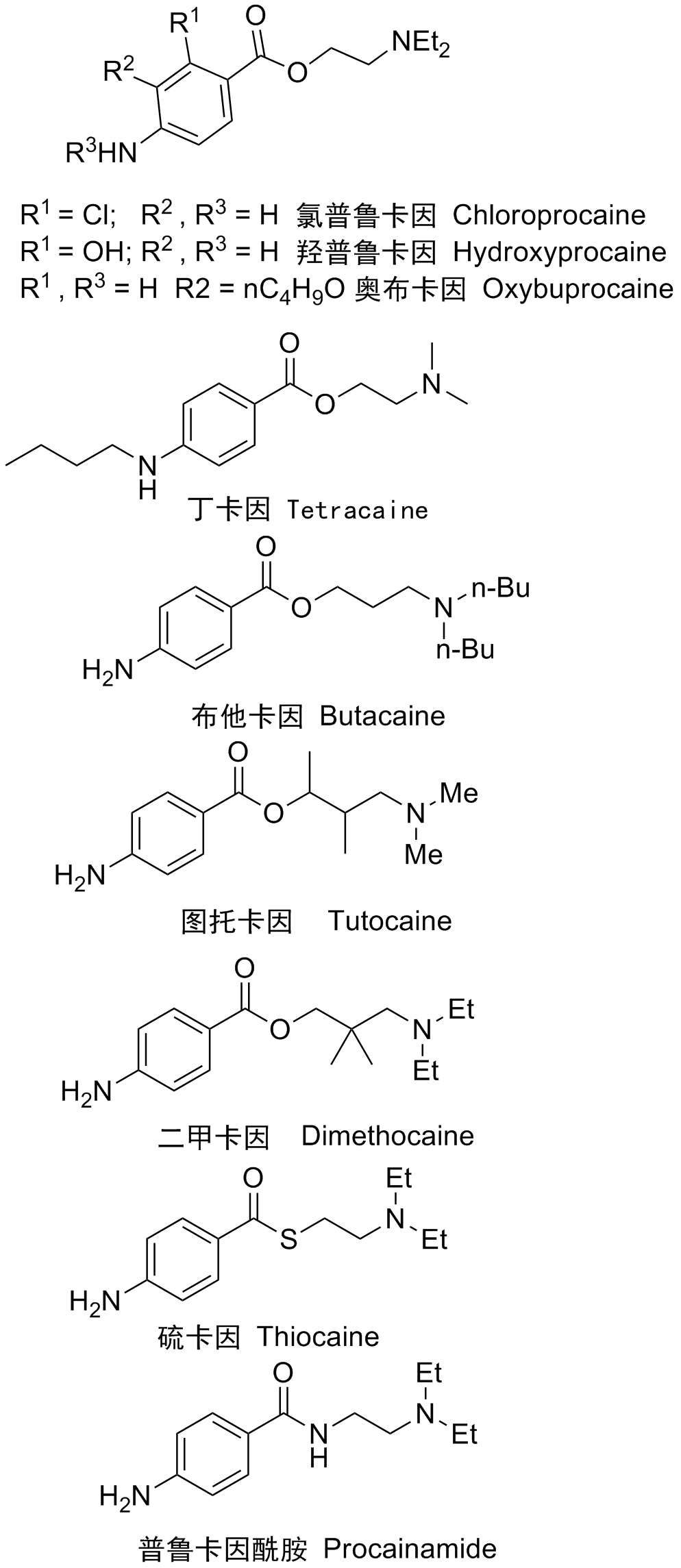
- Amino amide LAs, amino ester LAs
Lore & Background
Local anesthetics are classified into two main types: amino amides and amino esters. Cocaine is a naturally occurring ester, not a synthetic derivative. The suffix '-caine' at the end of these medication names is derived from the word 'cocaine', because cocaine was formerly used as a local anesthetic. Unlike cocaine, which causes vasoconstriction and hypertension, most other local anesthetics cause vasodilation and do not typically cause hypertension. Examples of local anesthetics vary by duration and potency. Short-duration, low-potency agents include benzocaine, procaine, and chloroprocaine. Cocaine is unique due to its vasoconstrictive properties and is not typically grouped with these agents. Medium-duration, medium-potency agents include articaine, lidocaine, and prilocaine. High-duration, high-potency agents include tetracaine, bupivacaine, cinchocaine, and ropivacaine. Local anesthetics are used in various techniques such as topical anesthesia, infiltration, brachial plexus block, epidural block, spinal anesthesia, and iontophoresis. They are also used in the 'dibucaine number' test for diagnostic purposes and as anti-arrhythmic agents (e.g., lidocaine).
Reader's Guide
Local anesthetics are significant in medicine for their ability to prevent and treat acute and chronic pain, and as a supplement to general anesthesia. They enable a wide range of surgical and diagnostic procedures—from bone marrow aspiration to insertion of IV devices—by providing targeted pain relief without loss of consciousness. Many anesthetists, surgeons, patients, and nurses believe it is safer to perform major surgeries under local anesthesia than general anesthesia. However, repeated local anesthetic blocks for chronic pain are not recommended due to lack of evidence of long-term benefits. Side effects can include localized edema, blanching of tissues, and systemic effects on the central nervous system and heart, though toxicity is rare with proper technique. The risk of permanent nerve damage is low, with 92–97% of affected individuals recovering within four to six weeks. Emotional reactions such as vasovagal collapse or hyperventilation may occur due to fear, emphasizing the need for a comfortable setting during administration.
Did You Know?
- The suffix '-caine' in local anesthetic names is derived from 'cocaine', which was formerly used as a local anesthetic.
- Unlike cocaine, most local anesthetics cause vasodilation and do not cause hypertension.
- Local anesthetics can be used as anti-arrhythmic agents, such as lidocaine.
- Permanent nerve damage after a peripheral nerve block is rare, but recovery rates vary and are not widely established as 92–97% within four to six weeks.
Classification and the Cocaine Connection
Local anesthetics fall into two broad families. The clinical group splits into amino amide and amino ester compounds, while the synthetic group traces its lineage back to cocaine itself. This historical link is not merely academic—it is embedded in the very names of the drugs. The familiar "-caine" suffix found at the end of nearly every local anesthetic name is a direct linguistic inheritance from cocaine, which was once the go-to agent for numbing a specific region of the body. Modern synthetic derivatives of cocaine have been engineered to strip away the most dangerous properties of the original compound. Unlike cocaine, these newer agents carry a far lower potential for abuse and generally avoid triggering the dangerous combination of hypertension and vasoconstriction, though a small number of exceptions exist. This evolution from a powerful stimulant with anesthetic properties to a refined, safer class of numbing agents illustrates how medicine can repurpose a dangerous substance into a controlled therapeutic tool.
A Toolkit for Pain and Procedure
The clinical reach of local anesthetics extends far beyond the operating room. They serve to prevent and manage both acute and chronic pain, and they can supplement general anesthesia when a full loss of consciousness is unnecessary. Delivery techniques are remarkably varied: topical creams, gels, or sprays dissolved in carriers like DMSO; direct tissue infiltration; targeted nerve blocks including brachial plexus, epidural, and spinal blocks; and even iontophoresis. In acute pain management, conduction anesthesia often outperforms standard analgesics, offering superior control with fewer side effects, and drugs can be delivered via repeated injection or continuous catheter infusion, sometimes combined with opioids for synergistic action. For chronic pain, local anesthetics may be applied over prolonged periods alongside opioids, NSAIDs, and anticonvulsants, though repeated blocks lack evidence of long-term benefit. In surgery, virtually any body region can be targeted, and many clinicians consider local anesthesia safer than general for major procedures. They also ease diagnostic procedures like lumbar punctures and bone marrow aspirations, facilitate insertion of pacemakers and chemotherapy ports, and enable painless venipuncture through topical lidocaine-prilocaine cream. Endoscopic work such as bronchoscopy and cystoscopy likewise benefits from surface anesthesia.
A Spectrum of Duration and Potency
Local anesthetics are not a one-size-fits-all category. They are stratified into three tiers based on how long their numbing effect lasts and how potent the agent is. At the short-duration, low-potency end sit benzocaine, procaine, chloroprocaine, and cocaine—agents suited for brief, superficial numbing tasks. The medium tier, offering a balance of duration and strength, includes articaine, lidocaine, and prilocaine; lidocaine in particular has crossed into other therapeutic roles, such as serving as an anti-arrhythmic agent. At the high-duration, high-potency end are tetracaine, bupivacaine, cinchocaine, and ropivacaine, which provide prolonged anesthesia appropriate for longer surgical procedures or extended pain management. This graduated spectrum allows clinicians to match the pharmacological profile of the drug to the specific clinical need—whether the goal is a quick topical numbing of a fingertip for a blood draw, a medium-length block for a dental procedure, or a sustained nerve block that keeps a limb pain-free for hours after surgery. The choice among these tiers is a fundamental decision in any anesthetic plan.
Localized Reactions and Special-Population Risks
While local anesthetics confine their numbing effect to a targeted region, their side effects and safety considerations are anything but trivial. At the injection site, tissue swelling is common, often caused by accidental puncture of a small vein that allows blood to seep into surrounding loose tissue. Blanching—where the area turns white due to temporary vasoconstriction of local arteries—is also frequent, though blood flow typically returns to normal within two hours. During an inferior alveolar nerve block, patients may feel tense, clench their fists involuntarily, and moan. Soft tissue anesthesia tends to outlast pulpal anesthesia, making eating, drinking, and speaking difficult for a time. More serious risks include temporary or permanent nerve damage, the likelihood of which varies by the specific block and anatomical site. Haematoma formation is a particular concern during posterior superior alveolar or pterygomandibular blocks, where tissue density makes vessel injury more consequential. Patients with significant liver dysfunction face a markedly elevated overdose risk because the half-life of amide local anesthetics can be drastically prolonged. Pregnant patients may receive local anesthetics and vasoconstrictors, but clinicians must exercise heightened caution with any medication in this population.
Gallery
Frequently Asked Questions
Who is Local anesthetic?
Local anesthetic is a class of anesthesiology medications that temporarily silences all sensation, including pain, in a targeted body region while the patient stays fully conscious. It is distinct from general anesthetics, which shut down sensation across the entire body and induce unconsciousness.
What are Local anesthetic's powers/role?
Its core function is to block nerve signal transmission in a specific area, eliminating pain during or after surgical procedures. When directed at particular nerve pathways, it can also produce temporary paralysis in that region.
How does Local anesthetic's story end?
Its effects are inherently temporary because the body metabolizes and clears the compound from the target site. Amino amide members are broken down by the liver, while amino ester members are degraded by plasma esterases, after which normal sensation gradually returns.
Why is Local anesthetic important?
It lets patients undergo a wide range of procedures—from dental work to epidurals—while remaining awake, sidestepping the systemic risks and longer recovery associated with general anesthesia. It is a foundational tool in modern anesthesiology and surgical practice.
What is Local anesthetic's classification and naming origin?
The family is divided into amino amide, amino ester, and synthetic cocaine derivative groups, and virtually every member carries the suffix "-caine," a linguistic nod to its historical link to cocaine.
More in Medications And Drugs 25-30
Elsewhere in the Medications And Drugs universe
Spotted an error? Know more?
This is a living reference — every entry is fact-audited, and reader corrections feed straight into our audit queue. Suggest an edit · See this site's audit record